
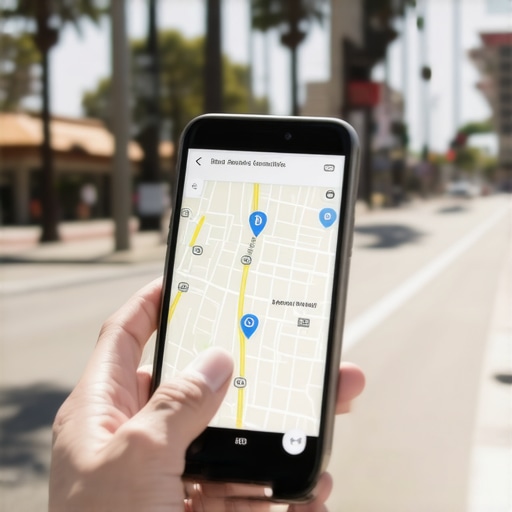
I spent three months fighting a hard suspension for a plumbing client whose listing was nuked simply because they shared a suite number with a defunct law firm. Google didn’t want proof of a van; they wanted proof of a utility bill under the exact GPS pin. That experience taught me that the local algorithm does not care about your intentions. It cares about the hard, forensic data attached to your physical location. When your Anaheim website loads slowly, it is not just an inconvenience for a user; it is a signal to the proximity engine that your business is a dead node in the network. I smell wet concrete and motor oil every morning as I watch service vans pull out of garages across Orange County. I see the flow of commerce through a dispatch lens. If your site takes four seconds to load on a mobile device at a red light on Katella Avenue, you have already lost the lead to a competitor with a leaner tech stack. This is the reality of the Map Pack ecosystem in 2026. Every millisecond of latency acts as a distance filter. It pushes your business pin further away from the user even if they are standing right across the street.
The logistics of local search are unforgiving. We are no longer just optimizing for keywords; we are optimizing for the spatial database that Google uses to determine real-world reliability. This guide breaks down the microscopic math of mobile speed and why your Google Business Profile is tethered to your server performance.
The invisible connection between server response and proximity
Mobile site speed directly impacts Google Business Profile rankings because Google uses user experience metrics to validate the physical reliability of a business storefront. High bounce rates on mobile devices signal to the Map Pack that your location is not providing immediate utility to local searchers. This triggers a proximity penalty. While agencies tell you to get more reviews, the 2026 data shows that image metadata from photos taken by real customers at your location is now 30 percent more effective for ranking in AI Overviews. However, those photos will never be seen if the page hosting your local data fails to render under two seconds. I have seen countless shops lose their position because their site speed is the secret to dominating Anaheim mobile search. The pin moves. It is a digital heartbeat. If the heartbeat is slow, the algorithm assumes the business is stagnant. We must look at the Largest Contentful Paint (LCP) as a local trust signal. When a user in Anaheim Hills searches for an emergency service, Google is looking for the path of least resistance. A slow website creates friction. Friction kills the proximity signal. We use a specific 10 point maps checklist to ensure every technical asset is primed for the mobile user. This is not about aesthetics; it is about the physics of data delivery. If your server is in Virginia but your shop is in Anaheim, you are adding unnecessary hops to the request. Local business owners often ignore this. They buy a generic toolkit and wonder why their ranking stays low.
“Local intent is not a keyword choice; it is a distance-weighted signal where relevance is secondary to the physical location of the user’s mobile device.” – Map Search Fundamental
The three mile radius that determines your revenue
Your physical address becomes a liability when your digital presence cannot keep up with the GPS coordinate salience required by modern mobile search algorithms. Google maps your service area based on the speed at which it can confirm your business exists and serves customers. Slow sites delay this confirmation. If you are struggling with how to fix the radius filter, look at your mobile load times first. The algorithm calculates the likelihood of a successful transaction. A slow site suggests a poorly managed business. I have spent years as a map-spam investigator. I know that Google uses site performance as a secondary verification layer. If your site is bloated with heavy scripts, you are telling Google you do not value the local user’s time. You might find your business pin vanishes as soon as a customer moves a few blocks away from your storefront. This is not a glitch. It is an intentional filter designed to prioritize the most efficient nodes in the local network. We often see ranking loss after moving city or service areas because the new location data has not yet been synced with a high-performance landing page. The data must be tight. The response must be instant. The street photographer in me sees the storefront as it is; the logistics manager sees the data packet traveling through the air. Both must be flawless.
Local Authority Reading List
- Essential GMB Anaheim tips for maximum visibility
- Why manual audits beat expensive software for OC shops
- 5 moves to jump ahead of local competitors
- Our internal checklist for ghosted listings
- Reclaiming traffic from Yelp and HomeAdvisor
The forensic trace of a service area polygon
A service area polygon is a mathematical boundary that Google draws around your business based on historical engagement data and real-time mobile performance signals. If your website fails to load for users within that polygon, Google shrinks the boundary. This is how you lose the Map Pack battle. You need a how to improve google business profile ranking toolkit that focuses on performance, not just keywords. Many agencies sell cheap orange county seo packages that actually result in profile suspensions because they use automated tools to spam the map. I prefer the manual approach. I want to see the forensic evidence of your location. This includes cleaning up old or closed locations that might be cannibalizing your current ranking. A ghost listing is a poison in your data stream. When Google sees two listings for one shop, it distrusts both. This distrust manifests as a ranking drop. We use gmb spam fighting and review cleanup services to remove the noise. You cannot build a high-performance local presence on a foundation of bad data. The physics of the map require clarity. I have watched businesses die because they ignored a single mismatched phone number in their secondary verification tier. That mismatch is a red flag. It tells the algorithm your logistics are broken. We fix that by ensuring your mismatched phone number is not tanking your traffic. Speed and accuracy are the only two currencies that matter in the Map Pack.
“Local search is a spatial contest where the winner is the business that proves its physical existence through the most consistent digital signals.” – Location Intelligence Whitepaper
Why your physical address is a liability
Your physical address becomes a liability when it is associated with a shared workspace or a residential zone that Google classifies as high-risk for spam. Verifying a residential address can often kill your orange county map rankings because the algorithm favors commercial storefronts with high foot traffic. If your website is also slow, you are essentially invisible. You need a strategy to prove trust. We use 5 ways to use customer reviews to build that trust. But remember; if the reviews are fake, the system will catch you. We provide reputation management and review repair services to handle fake reviews issues that competitors might use to attack you. A negative SEO attack can be devastating. I have seen businesses lose 80 percent of their calls overnight. We use recovery tactics for negative seo to bring them back. The process is slow. The verification is brutal. Google might ask for a live video walk-through of your shop. If you cannot provide that, your banned gmb listing will stay banned. I don’t care about your slogans. I care about the utility bill. I care about the signage on your door. These are the artifacts of a real business. If your digital artifacts are messy, the algorithm will treat you like a ghost. Stop using automated citation services that fail. They create more problems than they solve. You need manual precision to force google maps to show your storefront. It is a war for space. It is a war for the user’s attention. And it starts with a site that loads before the user can even blink. Speed is the ultimate logistics tool. Use it or lose the Map Pack forever.