How to Spot the Analytics Gaps That Make Your Orange County Map Presence Look Better Than It Is
I’ve spent over a decade in the trenches of local search, and if there is one thing I’ve learned, it’s that a “green” dashboard is the most dangerous thing a business owner can look at. I have seen countless Orange County businesses – from law firms in Irvine to HVAC companies in Anaheim – fail despite their reports showing upward trends. They see rising “Views” in their Google Business Profile (GBP) and assume growth is inevitable, while their phones remain stubbornly silent and their service bays sit empty. This is the “Vanity Metric Trap,” and it is currently the number one reason local marketing budgets are being lit ablaze.
The reality of the 2026 local search landscape is that Google’s reporting is designed to make you feel good, not necessarily to help you grow. We are currently navigating what I call the “Proximity Paradox.” You might rank #1 for your primary keywords when you are sitting at your desk in your office, but that doesn’t mean you rank #1 when a potential customer is standing at the Anaheim Packing House or walking through Old Towne Orange. If you aren’t identifying the massive gaps between what your analytics say and what your customers actually see, you are making decisions based on fiction. In this guide, we will dismantle the metrics that lie to you and show you how to find the real data that drives revenue.
Section 1: The “Views” Mirage, Why Impressions Are Often Meaningless
If you are looking at your google business profile insights and celebrating a 20% increase in views, I have some bad news for you: those numbers are likely a mirage. In the world of google business profile seo, “Views” (or impressions) is the most misunderstood and over-inflated metric in the industry. To understand why, we have to look at how Google actually counts a “view.”
Research from Sterling Sky has repeatedly shown that google maps impressions are incredibly volatile and do not represent actual human interactions. When a user searches for a broad term like “plumber near me” while driving down the 5 Freeway, Google Maps may display dozens of business labels on the screen. Every single one of those businesses – even the ones the user never looks at, clicks on, or even notices – is credited with a “view.” If a user scrolls past your map pin while looking for your competitor, you get a view. If your listing appears in the background of a map search for a completely different category, you get a view.
This creates a massive gap in your data. You might see 10,000 views this month, but if your google business profile clicks and calls haven’t moved, those views are worthless. They are “passive impressions” that reflect Google’s map density rather than your brand’s authority. To truly rank google business profile listings effectively, you must distinguish between “Interactions” and “Views.” Interactions – calls, website clicks, and direction requests – are the only metrics that correlate with actual foot traffic and revenue. If your views are climbing but your interactions are flat, you aren’t winning; you’re just part of the background noise. For a deeper look at this phenomenon, check out The Hidden Reason Anaheim Map Impressions Don’t Always Turn Into Calls.
Section 2: The Proximity Trap, Why Your Rank Tracker is Lying to You
Most Orange County business owners rely on a standard google maps rank tracker to tell them how they are performing. They log in, see a big “#1” next to their target keyword, and stop worrying. This is a catastrophic mistake. Standard SEO software often checks rankings from a single data center or a fixed zip code centroid. This fails to account for the “hyperlocal” nature of the 2026 map algorithm, which is more sensitive to a user’s physical location than ever before.
To understand why your reports are lying, you have to understand the “Three Pillars of Local SEO”: Proximity, Prominence, and Relevance. In 2026, Google has dialed the Proximity dial to the maximum. A business can rank #1 when the search is performed inside their own building, but they may vanish from the map pack entirely when a customer is just two blocks away in Fullerton or Orange. This is why using high-quality local seo ranking tools is non-negotiable. You need a grid-based view of your rankings, not a single point of data.
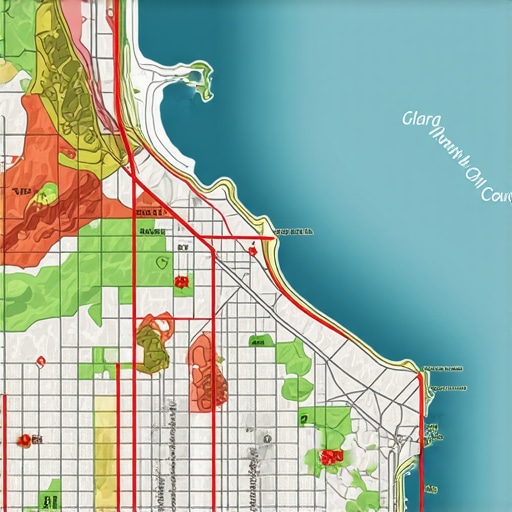
The Proximity Trap is particularly brutal in densely populated areas like Orange County. If your office is near the Platinum Triangle in Anaheim, you might dominate searches within a half-mile radius. However, as soon as a user crosses into the neighboring residential zones, your visibility might drop to position #10 or lower. If you are relying on a report that only checks from one spot, you are blind to the “dead zones” where your competitors are eating your lunch. This is Why your Anaheim business pin vanishes when customers drive two blocks away. To get a real sense of your reach, you must use a google maps ranking service that provides a multi-point geographic heat map. Only then can you see the true boundaries of your digital footprint.
Section 3: The “Ghost Pin” Phenomenon and Radius Filters
Even if you have a 5-star rating and hundreds of reviews, you might be suffering from the “Ghost Pin” phenomenon. This occurs when Google’s 2026 updates decide to “filter out” your business from the map pack in favor of a competitor, even if you are technically more relevant. This is a key part of google maps seo 2026 strategy that most agencies completely ignore.
Google’s algorithm includes a “distance filter” designed to provide variety to the user. If two businesses in the same category are located in the same building – or even on the same block – Google will often suppress one of them to avoid showing “duplicate” results. If you are a lawyer in a high-rise in Irvine or a dentist in a medical plaza in Anaheim, you are at high risk of being filtered out. Your google business profile ranking might look great in some tools, but for a real user, your pin is a “ghost” – it exists, but it’s hidden behind a competitor’s listing unless the user zooms in significantly.
To rank in google map pack results consistently, you have to prove to Google that your “entity” is more prominent than the neighbor’s. This involves more than just keywords; it requires building local “Prominence” through geo-specific content and review semantics. If your reviews mention specific Orange County landmarks or neighborhoods, Google begins to associate your business with the broader area, helping you break through the radius filter. If you’re struggling with this, you need to look into Anaheim SEO: 3 Fixes to Beat the 2026 Map Filter to ensure you aren’t being silenced by a nearby competitor.
Section 4: Silent Killers, Technical Gaps That Metrics Don’t Show
Your dashboard might show that you are ranking well, but it won’t show you the technical “silent killers” that prevent those rankings from converting into customers. A comprehensive local seo audit often reveals that the most significant barriers to growth aren’t related to keywords at all. They are technical failures that frustrate users and signal poor quality to Google.
The first silent killer is NAP (Name, Address, Phone) inconsistency. If your business is listed as “OC Plumbing” on Google but “Orange County Plumbing & Drain” on Yelp or your local Chamber of Commerce site, Google loses confidence in your data. Nap consistency seo remains a foundational ranking factor in 2026. These discrepancies are often invisible on a standard GBP dashboard but are glaringly obvious to a google business profile audit tool. I recommend using google business profile audit tool to scan the web for these fragmented citations.
Another silent killer is the mobile landing page experience. Most map searches happen on mobile devices. If your “Website” button leads to a slow-loading, non-responsive page, the user will bounce back to the map and click your competitor. Google tracks this “pogo-sticking” behavior and will eventually demote your listing. You can have the best google business profile seo in the world, but if your technical foundation is cracked, you are pouring water into a leaky bucket. Don’t let your hard-earned traffic go to waste; address the 7 citation errors that keep your Orange County shop invisible to local searchers before you spend another dollar on ads.
Section 5: Beyond the Dashboard, How to Conduct a Real Audit
Automated local seo software is a great starting point, but it is not a replacement for a manual, expert-led audit. To truly achieve google business profile optimization, you have to look at the data Google *doesn’t* show you in the dashboard. You need to look at your “unstructured citations” and your “entity strength.”
A manual audit involves looking at local news mentions, sponsorships of Orange County events, and backlinks from local organizations like the Anaheim Ducks or local community colleges. These are the signals that tell Google you are a legitimate part of the Orange County fabric. The best local seo tools can help aggregate this data, but they can’t interpret the nuance of local relevance. For example, a link from a Fullerton-based food blog is worth ten times more to an Anaheim restaurant than a generic “Top 10” list from a national site.
Furthermore, you should be analyzing “Review Semantics.” What words are your customers actually using? If you are a “Personal Injury Lawyer” but your reviews all talk about “Car Accident Settlements,” you need to align your profile’s categories and services to match the consumer’s language, not just the industry jargon. This level of insight is Why Manual Map Audits Beat Expensive Software for Orange County Rankings. By combining the data from a google maps ranking service like google maps ranking service with manual local expertise, you can close the analytics gaps that your competitors don’t even know exist.
Conclusion & CTA
At the end of the day, your business doesn’t run on “Views” or “Impressions.” It runs on phone calls, foot traffic, and signed contracts. If your current marketing reports are filled with upward-trending charts but your bank account isn’t seeing the same growth, you are likely a victim of the analytics gaps we’ve discussed today. The “Vanity Metric Trap” is easy to fall into, but it is devastating for long-term growth.
Stop trusting the default “green” charts in your dashboard. It’s time to look at the reality of your proximity reach, your radius filters, and your technical health. If you want to see what’s actually happening under the hood of your local presence, you need to go beyond the basics. Start by auditing your listing for the The Lead-Gen Checklist Most Anaheim Profile Audits Skip. Don’t let your Orange County business be a “ghost” on the map. Take control of your data, fix the gaps, and start turning those map views into real-world revenue.